How AI Has Been Integrated Into SCADA Systems Explained 2026
InfoNest Team
January 27, 2026
331 views
How SCADA has changed since AI came along
AI integration in SCADA systems showing intelligent industrial monitoring and automation dashboard(1)In power plants, water treatment plants, oil refineries, and factories, SCADA systems work quietly yet are incredibly crucial. For decades, Supervisory Control and Data Acquisition (SCADA) systems have been the primary means of monitoring and controlling the industry. They collect data, sound alerts, keep track of events, and allow operators to send orders. This model worked well when systems were smaller, slower, and easier to predict.
That place is no longer there.
Modern industrial processes get a lot of real-time data from thousands of sensors, smart devices, and networked subsystems. It's much more expensive now to have broken equipment, and it's difficult to keep an eye on things just by following the guidelines. No matter how effective they are, people can't always keep an eye on every variable in real time.
AI plays a crucial role in this situation.
SCADA is still here, and AI hasn't taken its place yet. Instead, SCADA systems now have AI, which lets them predict, change, and be aware of what's going on around them. AI-powered SCADA systems can discover small faults, foresee difficulties, and improve performance on the fly. They can also assist humans make better choices instead of waiting for problems to happen.
The transformation in real life is like changing from a simple warning light to a navigation system that can predict traffic, suggest different routes, and adjust in real time.
What does SCADA mean?
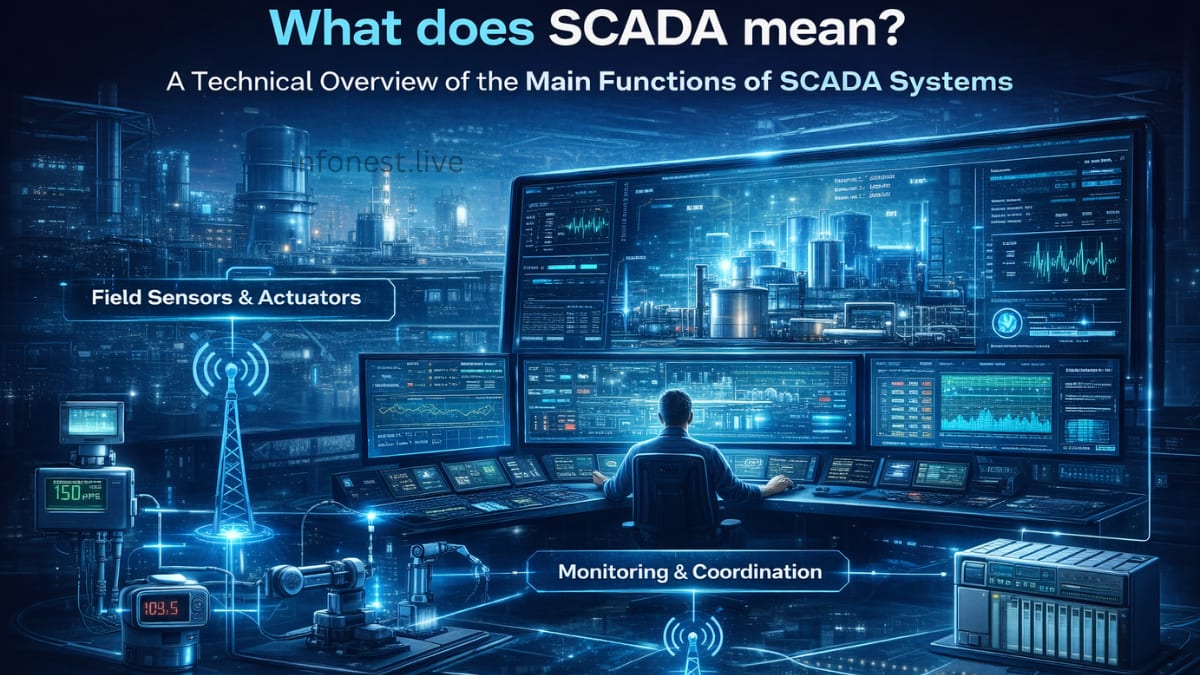
SCADA system architecture showing field sensors, PLCs, SCADA servers, and centralized industrial monitoringA Technical Overview of the Main Functions of SCADA Systems
SCADA is a technology that lets you watch and control industrial activity from one spot. It gets real-time data from field equipment that is spread out, analyses it, and displays it to operators using visual interfaces. After then, operators can respond to alarms, look at trends, and provide commands to control.
It's important to be clear about this: SCADA doesn't actually perform low-level control logic; it just monitors over and coordinates processes. That is the job of PLCs (Programmable Logic Controllers) and RTUs (Remote Terminal Units). 👉 https://www.infonest.live/blog/what-is-plc-programming
Important Parts of Traditional SCADA Architecture
These are the parts of a conventional SCADA system:
Field devices are sensors and actuators that keep track of things like flow, pressure, temperature, voltage, vibration, and more.
Ethernet, radio, cellular, and fibre are all types of wired or wireless connections that make up a communication network.
The major systems that gather and process data are SCADA servers.
Human-Machine Interfaces (HMIs): Operators use dashboards.
Historians: Databases that keep track of time-series process data.
Before, SCADA intelligence was only able to use static logic, rules, and thresholds.
Issues with Old SCADA Systems
It's commonly known that traditional SCADA systems are strong and reliable, yet they have several problems.
Behaviour Based on Rules and Responses
When something goes wrong, classic SCADA takes action. When numbers fall over or below specific levels, alarms go out. This works for simple failures, but it doesn't work well for more complex, nonlinear systems where early warning signs are hard to observe.
Too Much Data and Scalability
Because there are more industrial IoT devices, SCADA systems have to handle a lot more data than they were designed to. It is not possible for people to look at thousands of signals at once, which means they miss critical information.
Sick of alarms
Operators are overwhelmed when there are too many sirens. Nothing is important when everything is. This problem is well-known in industrial safety literature, and it is a major source of operational risk.
These limits made it especially appealing to add AI to SCADA systems..
Why AI is in SCADA systems now
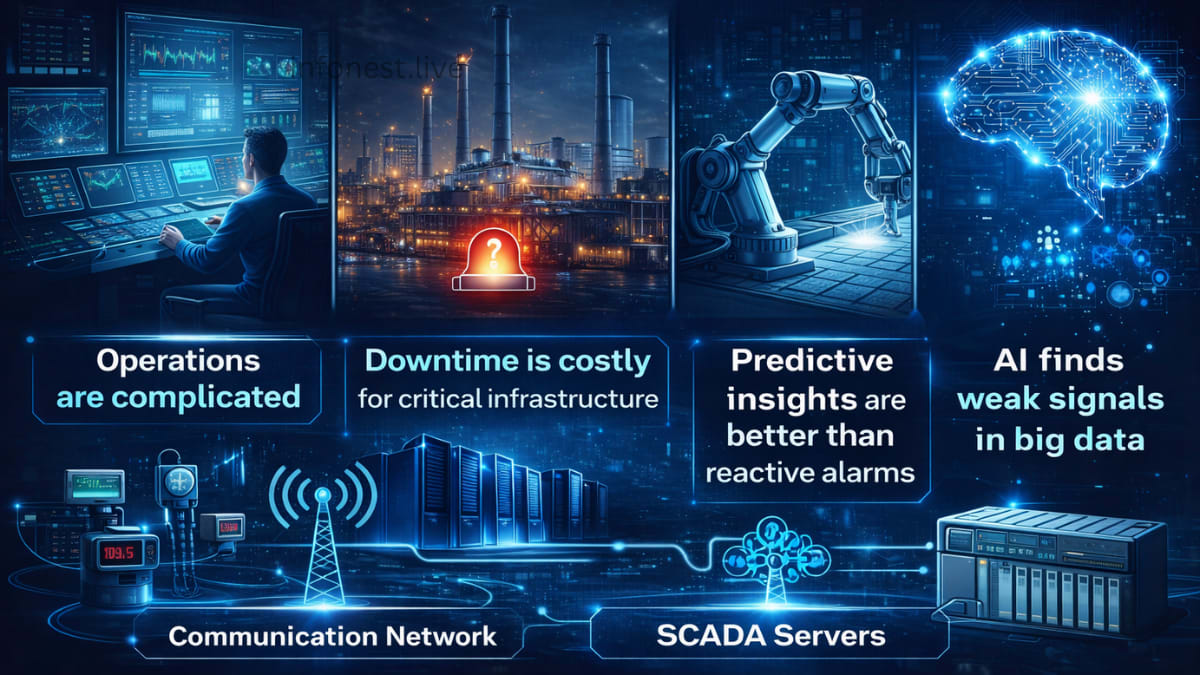
Reasons why AI is used in SCADA systems including complex operations, predictive insights, and big data analysisWhat makes AI useful in SCADA is that it is necessary, not just hype.
People don't get how hard operations are.
It's especially expensive for important infrastructure to be down.
It's better to know what's going to happen than to have alarms that go off when something does.
Processes that are always changing take too long to optimise by hand.
AI is good at finding weak signals, spotting patterns in big data sets, and changing to fit new situations. SCADA needs these skills, but it doesn't have them.
SCADA Systems Use These Core AI Technologies
Using Machine Learning in SCADA Systems
Machine learning algorithms look at both new and old SCADA data to find patterns, correlations, and differences. When you add new data, rule-based logic doesn't get better, but ML models do..
A lot of people use it for:
Predicted maintenance
Improving processes
Finding strange things
Deep Learning for Complex Industrial Systems
Deep learning models, like neural networks, are useful when it's challenging to represent how variables are related to each other in a straight line. They are often used to look at signals, figure out what's wrong with equipment, and look at pictures.
Using Computer Vision in SCADA Systems
By combining cameras with AI vision models, SCADA systems can keep an eye on equipment, locate leaks, spot safety violations, and review operations without any aid from people.
Natural Language Processing (NLP)
NLP enables people to talk to SCADA systems in plain English. Instead of dealing with numerous options, operators can ask questions like "Why did pressure drop in Zone 3?" and obtain answers that make sense in the situation.
How AI has been used in SCADA systems
This is the main idea of the subject.
Putting data together, cleaning it up, and putting it in context
AI models need data that is structured and free of errors. Raw SCADA data often has noise, missing values, and timestamps that don't match. New SCADA designs process data before transferring it to AI pipelines. 👉 https://www.infonest.live/blog/m2-vs-nvme-real-differences
This step is necessary for AI outputs to be reliable, yet marketing brochures often downplay this issue.
AI Analytics on SCADA
Most of the time, AI isn't integrated into the basic control logic. The present SCADA architecture is on top of an AI analytics layer. This layer sends data to operators or automated controllers by looking at live data streams.
This strategy decreases the danger and keeps the system reliable.
Edge AI vs. Cloud AI in SCADA
Edge AI operates close to the process, which makes it safer and less laggy.
A lot of the time, systems use a blend of several ways. There isn't one "best" approach; the trade-offs depend on variables like safety, latency, and rules.
Digital Twins with SCADA and AI power
Digital twins employ AI models with SCADA data to create models of objects that exist in the real world. Operators may try out numerous scenarios, estimate what will happen, and improve operations without putting real equipment in danger.
Using AI for SCADA Predictive Maintenance
Switching from maintenance that reacts to problems to maintenance that predicts them
Maintenance solutions that have been available for a while are either reactive or time-based. Neither of them works well. AI-enhanced SCADA can undertake predictive maintenance by figuring out how probable a problem is to happen before it occurs.
AI Models Used to Predict Problems
Some popular ways are:
Models for regression to figure out how much useful life is left
Models for determining out what sort of failure it is
Neural networks for complex interactions between sensors
Models for figuring out time series
These models can alter depending on how they are used, which is not possible with static alerts.
Real-World Effects on Business
In power generation, AI can tell when bearings may break weeks before they happen. In manufacturing, it finds wear patterns before the quality drops. A lot of industrial automation companies talk about these use cases, but the exact performance relies on how they are set up.
Using AI to Find Strange Things in SCADA Systems
AI is amazing at noticing when things don't go as planned, even when everything is still in its right place. This multivariate detection finds problems that normal thresholds can't.
Cybersecurity and finding intrusions
AI models that have learnt how networks usually work could notice abnormal communication patterns, orders that aren't allowed, and access attempts that aren't normal. This method is proactive and doesn't need a signature.
Reducing False Alarms
AI stops sending you annoying alerts and instead focused on serious threats by keeping track of what's happening on. This fixes the problem of alarm weariness immediately away, which is a known safety hazard.
Improving Processes with AI-Enhanced SCADA
To attain the optimum quality, efficiency, or energy savings, AI models adjust the settings on controls all the time. AI-driven optimisation makes changes happen right away, whereas static setpoints don't.
AI can help cut down on use without impacting production, particularly when it comes to energy optimisation
AI-Powered Decision Support Systems in SCADA
SCADA systems with AI don't just show data; they also explain it. They don't just display operators' raw trends; they also tell them what to do with them.
It's crucial to remember that AI doesn't replace human judgement. In most industries, operators still have the last say, which is both a safety need and a legal obligation.
Artificial intelligence, SCADA, and the Industrial Internet of Things (IIoT)
The IIoT makes data much better and more useful. AI leverages this information to get deeper insights, and cloud platforms help businesses improve in all areas.
Even while modern computer systems have made it easier to undertake real-time analytics, scalability is still a concern.
AI-Powered Interfaces and Visualisation
AI-powered dashboards alter depending on how you use them. Voice interfaces and augmented reality make things easier to use when you're in a dangerous or stressful situation, but not everyone utilises them because they cost a lot and need to be learnt.
Issues with integrating AI into SCADA systems
It's important to be realistic.
AI works better when the data is of high quality.
Updating old systems takes a lot of money.
You need to be able to explain things.
AI can make cyber risks worse if it isn't handled properly.
Vendors don't often talk about these issues enough in their ads.
Benefits of SCADA Systems with AI
Operations that work better
Less time spent on repairs and downtime
Better safety and following the regulations
Making better decisions
Assets will last longer.
There is a lot of proof that these things are good for you, but how well they work relies a lot on how well you use them.
How Companies Use SCADA with AI
Keeping the grid stable and adding power from renewable sources: energy and power
Water and sewage: fixing leaks and cleaning up the water
Oil and gas: watching pipes and making sure they are safe; smart factories and making sure the quality of the products during production
What AI Will Do in SCADA Systems in the Future
In the future, SCADA systems will be able to work on their own, be more flexible, and get better on their own. There are new things happening, like digital twins, generative AI, and infrastructure that can fix itself.
But as autonomy expands, ethical, legal, and governance frameworks will be increasingly crucial.
Final Thoughts: SCADA's Smart Future
AI has turned SCADA from a tool that only reacts to problems into a layer of intelligence that can predict and adapt to changes in how things are done in factories. AI-powered SCADA systems make things safer, more efficient, and better at making judgements without taking away people's control.
The technology is good, but not amazing. The performance will depend on the quality of the data, the architecture of the system, and the right governance.
Commonly asked questions
1. How have AI systems begun to work with SCADA systems? By using real-time SCADA data, analytics layers, predictive models, digital twins, and decision-support systems.
2. Does AI replace SCADA operators? No. AI doesn't take the place of operators; it makes them better.
3. What kinds of businesses benefit the most from AI-based SCADA? Water, energy, oil and gas, manufacturing, and transportation utilities.
4. Are SCADA systems that use AI safe? They can be safer, but only if cybersecurity is handled well.
5. What will AI do in the future to help automate factories? Systems in factories that can run on their own, get better, and fix themselves.